
Stories
CHILL Clips
Ready to CHILL for Change?
he eight Muslim women featured in this campaign—an assistant principal at a special needs school, a gymnast, a yoga and well-being instructor, a community worker, a public servant, an operations engineer and YouTuber, a primary school teacher, and an artist—are beautiful examples of the talent, success, resilience, and tenacity within the Muslim community of Aotearoa.
These stories have been shared, not just to highlight each Muslimah’s individual achievements; but to educate all, uplift our community, and challenge the harmful stereotypes that have long been directed at Muslim women. Now is the time to listen, learn, and stand alongside these incredible women as we address gendered Islamophobia together across the nation.
We ask all New Zealanders to CHILL with us—CHallenge Islamophobic Language and Loathing—and join us in creating a more understanding and welcoming society.
From Asylum Seeker to Change Maker: A Muslim Women’s Journey to Leading Action. Meet - Rizwangul
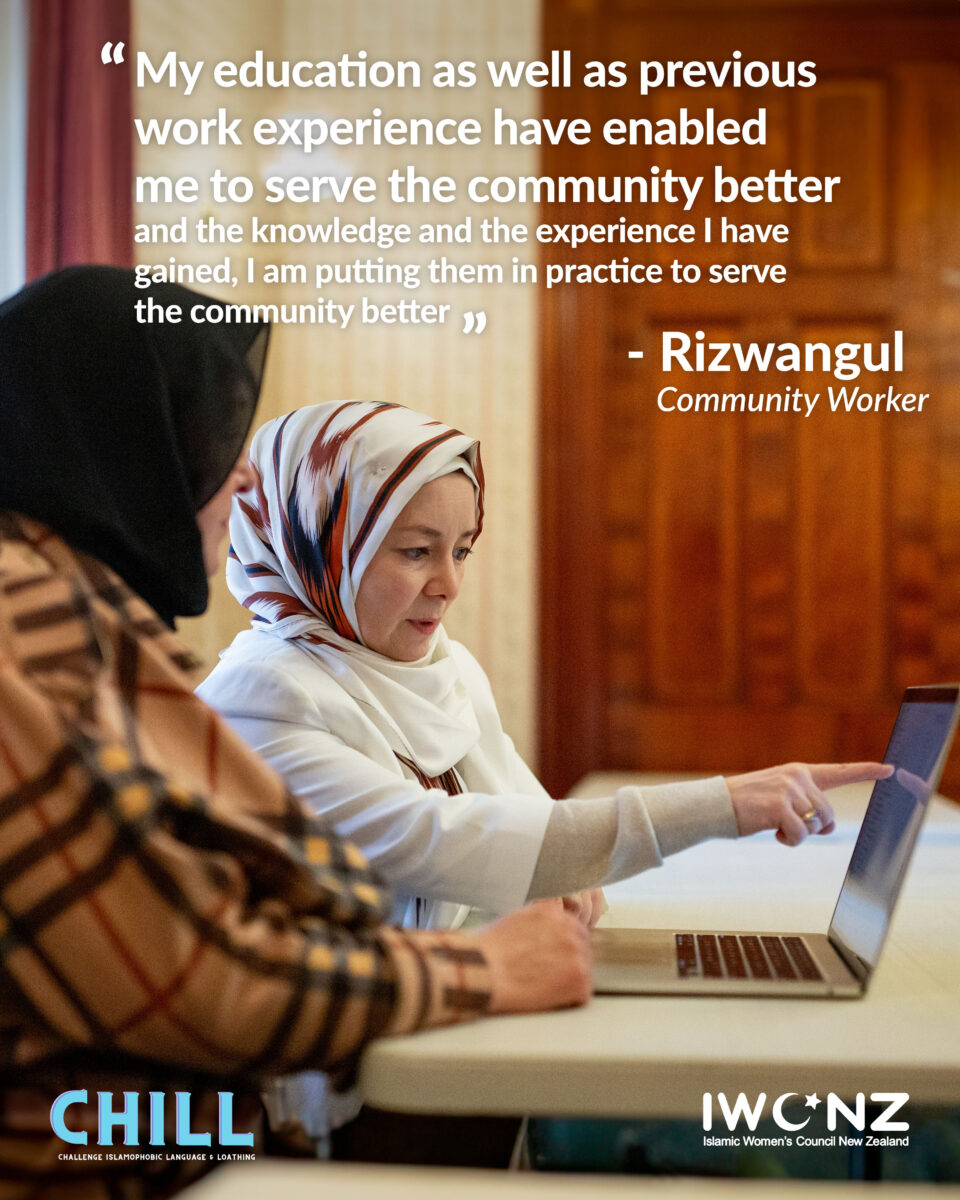
Rizwangul is a leader and advocate for migrant and refugee communities in Aotearoa. Arriving in New Zealand in 2010 as an asylum seeker, she has since used her experiences into a driving force for change. As the co-founder of a community trust, Rizwangul delivers educational and wellbeing projects across Auckland and beyond. With a background in government and community work, she is focused on improving the lives of refugee and migrant families. Her expertise lies in understanding the unique challenges these communities face and developing tailored solutions.
Rizwangul holds two master’s degrees, including one in Public Administration, which she completed as a Fulbright Scholar. Her pursuit of education is driven by a commitment to serving her community better. Through her charitable trust, she organises workshops that help parents from refugee and migrant backgrounds navigate New Zealand’s education system. Her work not only empower families, but also helps build a sense of belonging and inclusion.
Rizwangul’s lived experiences and life story counter common negative tropes about Muslim women. Contrary to the stereotype of Muslim women being confined to traditional roles, Rizwangul is at the forefront of community leadership, creating impactful change. Her academic achievements and professional success challenge the notion that Muslim women are uneducated. Additionally, her efforts to bring together diverse communities highlight her commitment to inclusion and social cohesion, shattering the myth of cultural isolation.
Rizwangul’s dedication and leadership make her an inspiring role model, not just for Muslim women but for all who strive to make a difference in their communities.
Degrees of Change --How Dr. Hend, a Muslim Woman, is CHILLing Stereotypes and Building a Better World
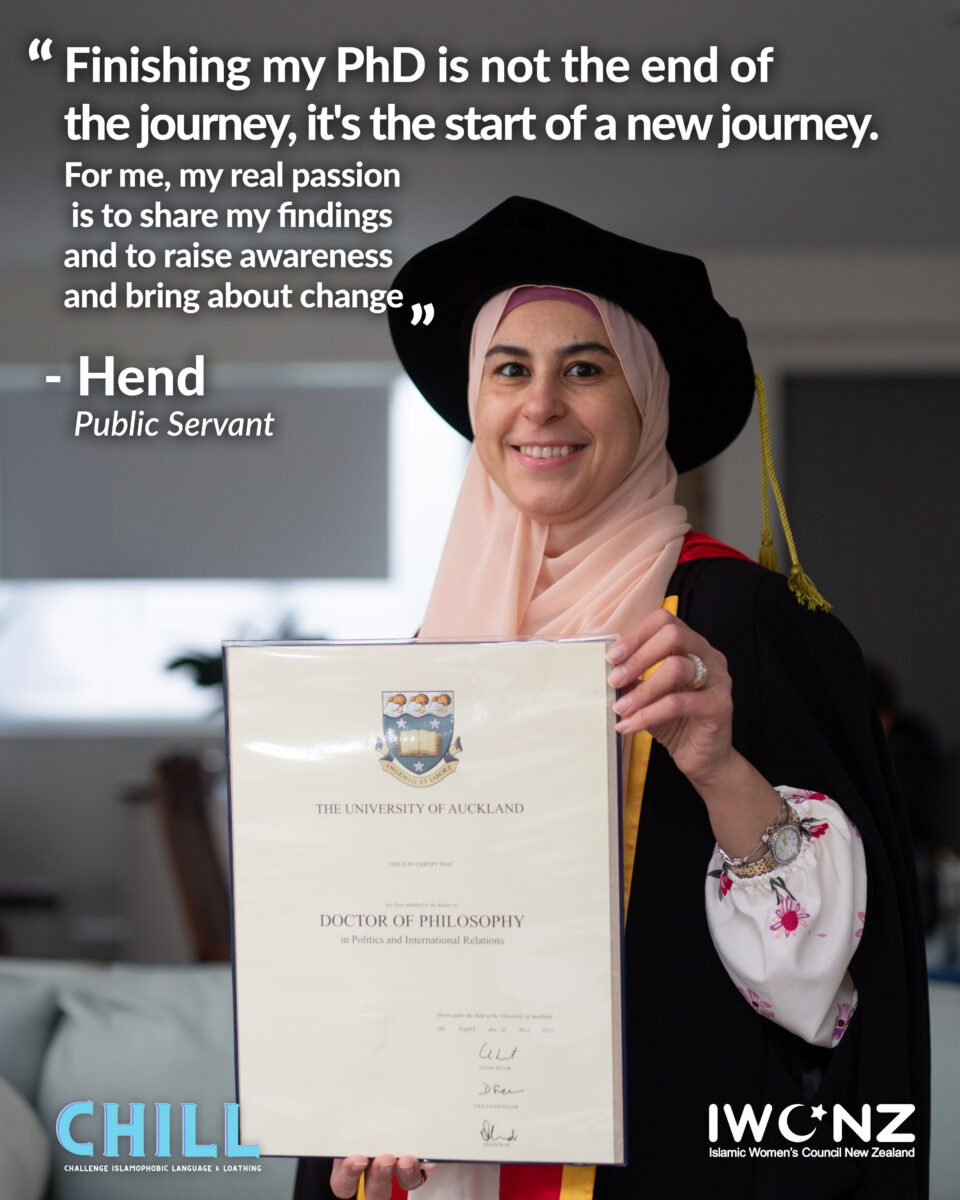
Originally from Egypt, Dr. Hend has called New Zealand home since 2015, bringing over 15 years of dedication to diversity and inclusion. With a PhD in Politics and International Relations, her research has focused on identity and belonging, particularly among Muslims born and raised in Aotearoa New Zealand and Australia. Through her work, she’s not only earned her title as a Doctor of Philosophy but actively works to support inclusion.
Dr. Hend leads initiatives in the New Zealand Public Service, like its Women of Colour in the Public Sector Network and, in her spare time, works to support leadership, identity, and Belonging programs based on her research and experience in inclusion and diversity and building a project to support Muslim women in that space. Her efforts to create a society where everyone can connect and thrive in welcoming spaces I most welcome to improving workplace outcomes.
Dr Hend’s own story counters stereotypes. Far from being passive, Dr. Hend shows that Muslim women are ambitious, they are driven, and they are capable leaders. Her choice to wear the hijab is a personal decision rooted in faith also demonstrates her autonomy and strength in the face of misconceptions.
Dr. Hend has also contributed to three national events with the Islamic Women’s Council of New Zealand (IWCNZ), by speaking and sharing her research findings and insights with our attendees.
In a world that often misunderstands Muslim women, Dr. Hend is “CHILLing” those misconceptions—changing perceptions and showcasing the diverse and dynamic roles that Muslim women play in society.
If you’d like to learn how to CHILL, to our website: justchill.org.nz
If you’d like to learn more about Hend’s Thesis, follow this link: https://researchspace.
For those in the NZ Public Service who would like to be part of the employee-led network, please follow this link: https://employeenetworks.govt.
#Education #Leadership #BreakingBarriers #CHILLCampaign #WomenInLeadership #Inclusion #Diversity
Breathe in Compassion, Breathe out Community—Meet Heba, a Muslim female yoga instructor
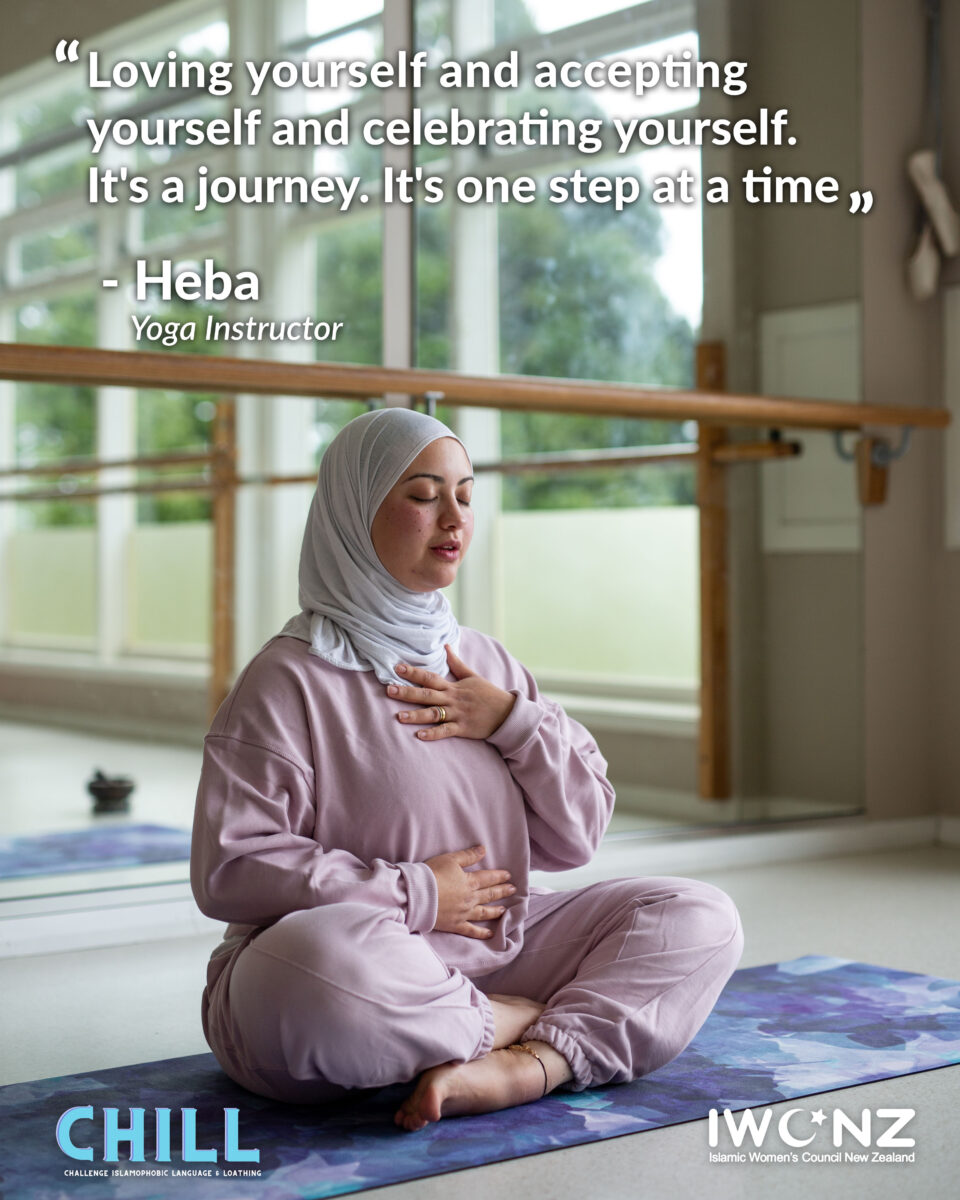
Heba, a former telecom engineer from Egypt, is now a dedicated yoga instructor. After a life-changing car accident, Heba found solace and purpose in yoga, transforming her career path to focus on wellness and community care. Her story is one of resilience, passion, and the power of self-discovery.
She is a great example of compassion and community orientation, offering donation-based and free yoga classes to make wellness accessible to everyone, regardless of their financial situation. Heba believes in supporting her community by spreading love and care, making sure everyone feels welcome, supported, and valued.
Strike a pose for change! Heba’s professional and wellness milestones and her adaptability all challenge the stereotype that Muslim women are passive or confined in their options. Embracing the hijab and weaving her faith into yoga practice, Heba dismantles the belief that Muslim women cannot blend spirituality with modern lifestyles. Her devotion to mental and physical health, community service, and identity highlights the multifaceted and dynamic existence of Muslim women
We hope you find inspiration in Heba‘s journey, and we ask that you do your part to foster understanding, challenge misconceptions, counter gendered Islamophobia and highlight the strength and resilience of Muslim women everywhere. Let’s all CHILL! I
We also hope you’ll find inspiration in Heba‘s efforts to offer donation-based services and foster community contributions. Did you know that New Zealanders quietly give their time and resources to the sum of almost $3 billion annually, showcasing a high per capita giving rate? See: https://www.stuff.co.nz/
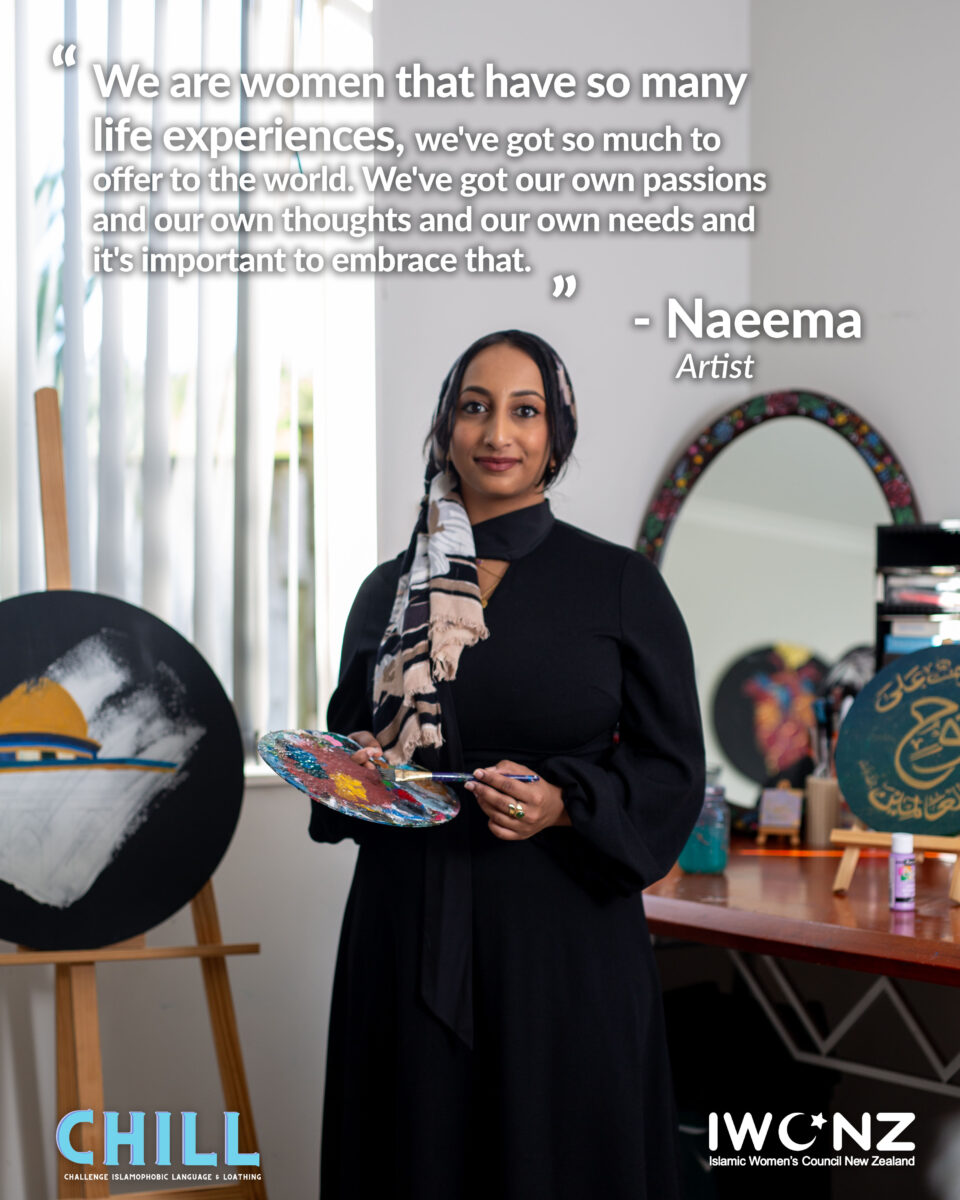
Meet Naeema and Her Layers of Talent - Colouring Outside The Lines
Meet Naeema, a shining example of how Muslim women are multi-dimensional and incredibly talented across various fields. Naeema is not just an artist, but also a dedicated public health professional specializing in cancer prevention.
Naeema’s passion for art goes beyond boundaries. Through her paintings, she expresses her creativity and raises awareness for global causes. Her charity art projects support issues facing the community, proving that art and Muslim women can be powerful positive tools for change. Naeema‘s workshops empower others to tap into their inner artist. By sharing her work, she touches lives, invokes emotions and sparks conversations
In her professional life, Naeema has developed a health model that integrates an Islamic perspective on holistic well-being. This model emphasises the importance of nurturing physical, emotional, social, environmental, and spiritual health, showcasing Naeema’s commitment to her community’s overall well-being.
Naeema’s story shows Muslim women are not confined to a single dimension and inspires us to look beyond stereotypes and recognise the diverse talents and contributions of Muslim women. Join us in celebrating Naeema and many other Muslim women defining themselves and just CHILL. If you’d like to know more about how to CHILL (Challenge Islamophobic Language and Loathing), please visit justchill.org.nz
We also encourage you to read more about diversity in the arts and suggest these two reports by Creative NZ : Visibility Matters Kia kitea ngā toi e te marea available here: https://creativenz.govt.nz/-/
And their Diversity Report available here: https://creativenz.govt.nz/-/
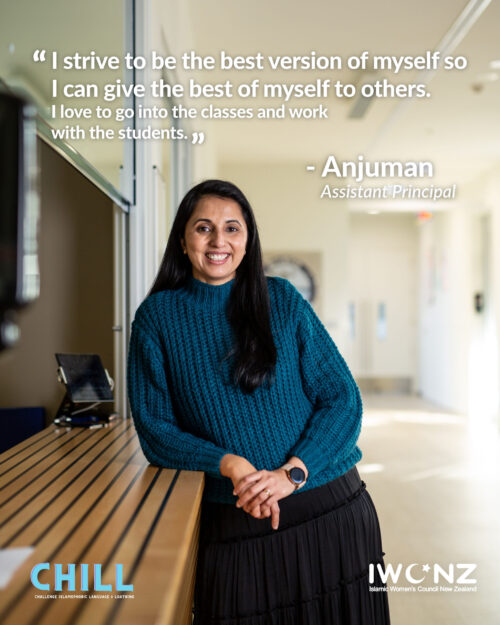
Muslim Women Leaders - Meet Anjuman
Muslim women lead. Anjuman’s story is a powerful example of that fact,. Over the past 15 years, she has made a positive impacted to New Zealand education, particularly in special education, proving that Muslim women can and do hold leadership roles effectively and inspirationally.
Originally from Fiji, Anjuman has dedicated 14 years to special education in New Zealand, now serving as an Assistant Principal. Her leadership journey, from a secondary school science teacher in Fiji to a senior leader in New Zealand, is marked by her commitment to staff management, curriculum development, and enhancing student achievement.
Like many female leaders, she balances her profession life with being a wife and a mother. As a family, they enjoy hiking, cooking, and spending quality time together.
Anjuman’s resilience and drive are truly inspiring. She makes a difference for her students, colleagues, and the wider community. Her commitment to inclusive education and staff development is creating a better future for many. IWCNZ would like to encourage more people from all communities Anjuman’s path to support inclusive education. We appreciate the work Whaikaha does and also highlight this research on Disability studies in and for inclusive teacher education in Aotearoa New Zealand. https://www.tandfonline.com/doi/abs/10.1080/13603116.2021.1882059
There has a notable underrepresentation of Muslim women in leadership roles in New Zealand. Addressing this gap requires inclusive leadership practices and providing platforms for diverse voices. Understanding this, IWCNZ has been working to address barriers and to increase the preparation of Muslim women in the leadership space, having successfully mentored 28 aspiring Muslimah leaders.
Generally, women in leadership roles often face challenges, including gender biases and underrepresentation. The work that the Ministry for Women does is vital to progress in New Zealand. In roads have been made the public sector and we look forward to further progress in private section. For more information visit https://www.women.govt.nz/women-and-leadership
Muslim Women Spreads Word On Holistic Living - Meet Ugeshni
Migrating from South Africa to New Zealand over two decades ago, Ugeshni has faced life’s challenges and growth with courage, proactiveness and vision. After entering Islam in 2013, Ugeshni also embraced a new path that led her to discover holistic living—a lifestyle that she openly and vocally advocates for today. Struggling with PCOS and depression, Ugeshni sought ways to improve her own well-being. This led her to holistic living, an approach that considers the whole person—mind, body, and soul. Through attending a range of courses, lectures, and seminars, she gained knowledge about maintaining a balanced and healthy lifestyle. She engages in activities such as gymming, hiking, and biking to maintain her physical fitness. Additionally, she grows her own organic vegetables and makes her own bread and meals from scratch, guarantees that what she consumes is nutritious and wholesome.
Ugeshni actively shares her insights on social media, where she educates and inspires others to improve their wellbeing and to embrace holistic living. Her social media content includes tips on fitness, nutrition, and mental well-being. Her work is garnering a quality following as Ugeshni uses her platform to make a positive impact.
As a solution-maker, Ugeshni embodies a ‘wholistic’ living philosophy and simply “hikes by” negative stereotypes about Muslim women’s passivity and inactivity. Her self-sufficiency and influential social media presence further dismantle the misconceptions of dependency and limited public engagement. Her work is help to ensure Muslim women’s voices are heard.
The underrepresentation and misrepresentation of Muslim women in media has been an issue in globally and in New Zealand. Specifically, the research confirms that media often uses negative portrayals of Islam and Muslims, frequently excluding or distorting actual Muslim voices, and reinforcing stereotypes through visual imager Global research also confirms that Muslims are underrepresented (25% of population yet just over 1% representation), often portrayed as violent or exotic, and Muslim women, when they do appear. are typically shown in submissive roles.
An example of NZ-based research can be found here https://ojs.aut.ac.nz/pacific-journalism-review/article/view/419
USC Annenberg research here: https://womensmediacenter.com/fbomb/muslim-representation-on-screen-has-a-long-way-to-go
Meet Nesra - Educator and Community Leader
We would like to present to you Nesra, an educator and community leader, as the second participant in our CHILL Campaign.
From arriving in New Zealand as a child without English to becoming a primary school teacher, Nesra has been a role model in education for six years now. Her story challenges stereotypes, showing that Muslim women are contributors to education and to New Zealand society. Her innovative teaching methods and commitment to inclusion are making a positive difference in her students’ lives and the wider community.
Outside of school, Nesra also supports the Somali community and promotes educational opportunities. She authored “Ko wai au?” for junior primary students, extending her impact on education. The book, which is part of a series collaboratively created by IWCNZ and the Ministry of Education, includes resources for teachers and can be found online here: https://newzealandcurriculum.
Diverse educators like Nesra are essential, as highlighted by the Education Review Office’s 2023 report. They serve as role models, bring cultural competence, and build stronger community connections, benefiting all students academically and socially.
https://ero.govt.nz/our-
Explore more about the CHILL Campaign and how to challenge Islamophobic language at our website justchill.org.nz.
Meet Samadiana - Gymnast and Nursing Student
The Islamic Women’s Council of New Zealand knows many that already do that, and we want to give a shoutout and appreciation to all the coaches, outdoor instructors, teachers and providers who are welcoming to diverse participants. At IWCNZ, we especially highlight Kate from First Step Outdoors who has worked with us to find those solutions for over 16 years, getting IWCNZ members scaling cliffs, paddling rivers, trekking through forests, and skiing down mountains. So when someone says, “Muslim women can’t,” please CHILL! And let them know, we’ve got this.
If you’re looking for advice on how to Challenge Islamophobic Language and Loathing, please visit www.justchill.org.nz Special appreciation goes to: DPMC, EYES AND EARS, Calvin and Ankita.